Celebrating Native Voices at Charlesbridge 0
In honor of Native American Heritage Month (and beyond), we're highlighting some of the our Native/Indigenous authors and illustrators in the Charlesbridge family and the books they have shared with readers. Our authors and illustrators invite readers to learn, connect, and see the world through different perspectives.
While these stories explore cultural traditions, history, and contemporary experiences, they also offer meaningful opportunities for readers to reflect on their own culture and traditions, and to consider the experiences of those around them.
With that in mind, we invite you to explore the books and voices we're celebrating this month and beyond.
Riding the Trail
Traci Sorell & Will Chavez

Follow Cherokee youths on a 950-mile bike journey retracing the Trail of Tears—from Georgia to Oklahoma—on the annual Remember the Removal Ride. This inspiring photo-rich nonfiction book follows Native youth riding to remember history, to link past and present through culture, to gain resilience, and to show activism. For ages 10 and up.
Best-selling author and Cherokee Nation citizen Traci Sorell writes inclusive, award-winning fiction and nonfiction in a variety of formats for young people. She is a two-time Sibert Medal and Orbis Pictus honoree for her nonfiction work. She is the author of We Are Grateful Otsaliheliga, We Are Still Here!, and Mascot, among many others.
Award-winning journalist, photographer, and Cherokee Nation and San Felipe Pueblo citizen Will Chavez previously coordinated the annual Remember the Removal ride from 2019–2024, participated in the inaugural ride in 1984, and served as a mentor rider in 2019. He is an assistant editor at the Cherokee Phoenix. He also serves on the board of directors for the National Trail of Tears Association.

"I hope Riding the Trail encourages readers to consider other chapters in this country’s history and think about what hasn’t been commemorated. The 1984 ride helped create the National Trail of Tears roadway markers and later an annual ride. What else needs to be remembered and shared for the greater good?" ~Traci Sorell

"I hope Riding the Trail fills a gap in American history that has been open for too long. While the forced removal of Native peoples from their lands is difficult to revisit, it is a vital part of this country's history that should not be ignored or forgotten." ~Will Chavez
Keepunumuk: Weeâchumun's Thanksgiving Story
Danielle Greendeer, Anthony Perry and Alexis Bunten; Illustrated by Garry Meeches Sr.

Written and illustrated by four Indigenous creators, this beautiful picture book honors both the history and tradition that surrounds the story of the first Thanksgiving through Wampanoag eyes. Native Americans teach the Pilgrims to grow the three sisters—corn, beans, and squash—for a successful harvest. For ages 3 to 7.
Danielle Greendeer is a citizen of the Mashpee Wampanoag Nation and works in the areas of tribal governance, cultural perpetuation, and food sovereignty. She lives in Mashpee.
Anthony Perry is a Chickasaw citizen and author of Chula the Fox, an award-winning middle-grade historical-fiction book. He lives in London.
Alexis Bunten, Yu'pik and Unangan, authored the award-winning nonfiction book, So How Long Have You Been Native? Life as an Alaska Native Tour Guide. She lives in Monterey.
Garry Meeches Sr. (Anishinaabe) was born on the Long Plains reserve in southern Manitoba, Canada. His style is reminiscent of the plains style of art and evokes the Eastern Woodlands tradition. He lives in Connecticut, and this is his first picture book.

"We hope that Keepunumuk sparks a conversation on who we are as a nation and our values. We want readers to see that America’s first people are still here, despite the odds. We also want them to appreciate land, animals and other people as relatives they depend on to thrive." ~Anthony Perry, Alexis Bunten, Danielle Greendeer
Kindred Spirits: Shilombish Ittibachvffa
Leslie Stall Widener; Illustrated by Johnson Yazzie

A nonfiction picture book about the inspiring true pay-it-forward story that bridges two continents, 175 years, and two events in history--connecting Ireland, Choctaw Nation, Navajo Nation, and the Hopi Tribe. For ages 5 to 8.
Leslie Stall Widener is a citizen of the Choctaw Nation of Oklahoma. She has illustrated six Choctaw-related picture books: Chukfi Rabbit’s Big, Bad Bellyache; The Turkey Who Liked to Show Off; Why the Turtle Has Cracks on His Back; The Story of Tanchi; Why the Possum Has No Hair on His Tail; and Why Rabbit Has a Short Tail. Leslie lives in McKinney, Texas, with her artist husband, Terry Widener.
Born on the Navajo Nation in Pinon, Arizona, Johnson Yazzie's interest in creation began in childhood and led to a lifelong career in fine art as a painter, bronze sculptor, and illustrator. Johnson illustrated Yossel's Journey by Kathryn Lasky. The Navajo word hózhó means balance, harmony, beauty. It is the word by which he lives.

"A small act of kindness can have a big impact. Having empathy and compassion for others makes the world feel smaller. There is hurt and injustice everywhere but helping those in our own community is a good place to begin. Changes result when even one person takes a stand." ~Leslie Widener
Napesni Renegade
Marci R. Rendon; Illustrated by Sam Zimmerman

Napesni likes to stamp his hooves and sniff and snort in the dry dust of Cheyenne River Reservation. That all changes, though, when ranchers capture him and bring him to Minnesota instead. Sad, lonely, and homesick, Napesni searches for his family and home in this adventurous story. For ages 3 to 7.
Marcie R. Rendon is an enrolled member of the White Earth Nation, author, playwright, poet, and freelance writer. Also a community arts activist, Rendon supports other Native creators and is a speaker for colleges and community groups about Native issues, leadership, writing. Marcie is an award-winning author of the Cash Blackbear Mystery series for adults and also has an extensive body of fiction and nonfiction works. She is the creative mind behind Raving Native Theater, curating community-created performances.
Artist and educator Sam Zimmerman is a proud direct descendant of the Grand Portage Band of Lake Superior Chippewa (Ojibwe). Drawing on ancestral connections, Sam continues the Anishinaabe tradition of storytelling, embedding themes of environmental stewardship and conservation in his studio and public art commissions. Sam illustrated Following My Spirit Home: A Collection of Paintings and Stories, a silver finalist for a Midwest Book Award, and How the Birds Got Their Songs. He lives in Duluth, Minnesota, and regularly explores the natural beauty of Minnesota’s North Shore as the artist in residence at Tettegouche State Park in Silver Bay.

"As a mother and grandmother I encourage everyone to live in ways to secure a future for all children seven generations ahead. Napesni Renegade is about a buffalo who finds his way home, and is also a story demonstrating how Native American nations model and practice food sovereignty for all." ~Marcie Rendon
Many Ways of Being Native
Ginger Reno; Illustrated by Johnson Yazzie

A lyrical picture book celebrating Native identity and diversity, perfect for a bedtime read along. A winged messenger visits two Native children in their sleep and shows them how other Native children have grown up, each with different interests, dreams, and appearances. A moving celebration of identity, belonging, and the truth that who we are is always enough. For ages 4 to 7.
Ginger Reno is a citizen of the Cherokee Nation, and her desire to learn about Cherokee history and culture naturally spilled over into her writing. She is the author of Find Her, an Edgar Award nominated middle-grade novel, and Spirit Shadow, a picture book. Ginger lives in Oklahoma within the Cherokee Nation and likes to spend as much time as possible on her lakefront porch with her two favorite people—her husband and their twelve-year-old German shepherd.
Born on the Navajo Nation in Pinon, Arizona, Johnson Yazzie's interest in creation began in childhood and led to a lifelong career in fine art as a painter, bronze sculptor, and illustrator. Johnson illustrated Kindred Spirits: Shilombish Ittibachvffa by Leslie Stall Widener and Yossel's Journey by Kathryn Lasky. The Navajo word hózhó means balance, harmony, beauty. It is the word by which he lives.

"We belong. Regardless of the color of our eyes, our skin, our hair. Inside, where it counts, we have the same strength of spirit our ancestors relied on to survive. And today, we can draw on that resilience to help us achieve whatever our dreams may be." ~Ginger Reno
Forever Cousins
Laurel Goodluck; Illustrated by Jonathan Nelson

In this Native American story, Kara and Amanda are best-friend cousins. Then Kara leaves the city to move back to the Rez. Will their friendship stay the same?
Native creators Laurel Goodluck and Jonathan Nelson share a sweet picture book with the universal experience of family and friends moving away.
Laurel Goodluck writes picture books with modern Native themes. Raised in the San Francisco Bay Area, Laurel comes from an intertribal family and is an enrolled Mandan Hidatsa Arikara Nation and Tsimshian tribal member. Laurel has degrees in psychology and community counseling and family studies. She lives in Albuquerque, NM, where they raised two children.
Jonathan Nelson is a Navajo graphic designer, graphic artist, and illustrator. He is Kiiyaa'áanii (Towering House Clan) and Naakai Dine'é (Mexican Clan). Jonathan designs and creates art and illustrations with paints, pixels, and ballpoint pens. He lives outside Denver, Colorado, with his family.

"My wish is for young readers to find comfort in knowing Kara and Amanda maintain their close bond despite the distance. I also hope adults use this story to discuss how cultural traditions can strengthen relationships. Equally important, I hope adults discuss the U.S. Indian Relocation Act and how U.S. federal policies continue to impact Native families." ~Laurel Goodluck
Charlotte's New Moccasins
Jenn Moudahi; Illustrated by Rhael McGregor

Charlotte has outgrown her moccasins! Still, there's nothing a trip to Grandma's can't fix in this heartwarming intergenerational story. A sweet, celebratory picture book about family and culture by two debut Métis creators centered around Indigenous peoples' tradition of making moccasins. For ages 3 to 7.
Jenn Moudahi is a Métis author, clinical counselor, and mom. Stories are a common thread in her life—she writes them as an author, listens to them as a counselor, escapes into them as a reader, and allows too many at bedtime as a mom. Growing up, Jenn spent countless hours with her own mom learning to create Indigenous art, often helping to teach workshops throughout British Columbia. Jenn lives in Western Canada with her husband, two kids, and two purrfect cats.
Rhael McGregor is a Winnipeg-based, Métis, and Two-Spirit/queer artist. Since stepping into storytelling in 2018, Rhael has been passionately telling stories as a writer and illustrator in hopes of all readers being able to see themselves in books. They love the winter, sweet treats, and doing beadwork for family and friends. They also illustrated Noodin’s Perfect Day.

"I hope Charlotte’s New Moccasins opens conversations about special people in our lives and cultural traditions in families. I’d love for kids to explore their own personal flair and creativity, just like Charlotte does when she designs her unique moccasins." ~ Jenn Moudahi
These books offer only a glimpse into the many stories, histories, traditions, and experiences of Native and Indigenous communities. We're grateful for our creators who share their voices and perspectives with readers so that we may learn from the past, while celebrating the present, and looking forward to the future.
Please check out our full Native/Indigenous list of books and continue to celebrate the many Native and Indigenous voices in children's literature.
Starting kindergarden or pre-school - tips 0
Starting kindergarden or pre-school - tips
- Donna Spurlock
- Tags: Anna McQuinn literacy reading Rosalind Beardshaw
The Whole Book Approach Goes Online: Tips to Enrich Storytimes During Periods of Emergency Remote Learning 0
By Megan Dowd Lambert
 My book, Reading Picture Books with Children: How to Shake Up Storytime and Get Kids Talking about What They See (Charlesbridge 2015) introduced the Whole Book Approach storytime model I developed in association with The Eric Carle Museum of Picture Book Art to a wider audience. Now that it’s in paperback, I’m thrilled to see my book reaching even more readers, and new Whole Book Approach Storytime Sets for grades pre-k through 5 from Steps to Literacy are poised to help educators shake up storytime in the new schoolyear. Each set includes a sturdy book bin holding:
- 10 picture books I selected by award-winning authors and illustrators (See grade-level book lists here)
- A Whole Book Approach Storytime Guide that I wrote for each grade level, with customized discussion plans, extension activities, and resources for all 10 curated books in each bin (See a sample plan here)
- “A Message from Megan” in each Guide, which introduces the Whole Book Approach and offers additional Critical Literacy resources (See excerpts from this piece here on the Diverse BookFinder site)
- A copy of Reading Picture Books With Children
I put my whole heart into this project, and I am so excited for the sets to find their way into classrooms; and yet, my excitement is dampened by the tremendous uncertainty facing educators and families alike as the 2020/2021 academic year looms before us in the midst of the ongoing COVID-19 pandemic. As a parent, I’ve been searching for resources to help guide and structure my children’s experiences with emergency remote learning since school shutdowns began in our community last March. Their teachers rallied to provide online learning, and I supported, encouraged, and augmented my children’s participation as best I could. As an educator, I also began trying to provide resources to help others. I co-authored an annotated picture book list for Embrace Race, I led professional development webinars, offered online storytimes with Link to Libraries and Story Starters, and gave online interviews. Given the fact that shutdowns seem more like an inevitability than a possibility for many schools during the upcoming academic year, I’ve also done a lot of thinking about how my new Whole Book Approach Storytime Sets might be most useful during periods of emergency remote learning.
First, although the household market wasn’t the planned target audience for the sets, I hope that some families with children in preschool and elementary school will be able to purchase Whole Book Approach Storytime Sets to enrich their picture book reading at home. During the spring 2020 shutdown, booklists, activity ideas, and homeschooling advice proliferated on the internet, leaving many people (including me!) feeling overwhelmed. Although the sets could be a big financial investment for an individual family to make, each one is a one-stop resource with 10 excellent picture books and associated discussion plans and activities for each title. I imagine families reading and rereading the picture books in their bins, and then expanding on those readings with the resources and activities paired with each title. (A pie-in-the-sky dream that would require major funding would be for schools to purchase Sets for every child in a classroom to take home in the event of a shutdown. Then, children and families would have access to the same books and resources, literally putting everyone on the same page.) Ideally, the Whole Book Approach tips and tools they use with their book bin titles will also help them see other picture books they have at home with new eyes.
As for how teachers and librarians might adapt the Whole Book approach for use in online programming and teaching, it might sound paradoxical, but I actually suggest that they hold back from doing whole Whole Book Approach readings online. Every plan in every Whole Book Approach Storytime Guide is filled with questions and prompts to guide storytime discussion about the titles I chose for the sets. Rather than restating those plans here, below, I emphasize quick comparisons, connections, definitions, and observations during online readings. It’s definitely harder to keep a group’s attention and to facilitate discussion in an online forum than it is to do so in an in-person storytime. I therefore think it’s best to use online Whole Book Approach storytimes as a means of introducing vocabulary and ideas about art and design, rather than trying to have full, lengthy discussions. As children engage in these quick conversations, tell them (and any grownups at home who might be supporting their learning) to take the terms, ideas, and questions you introduce and apply them to their reading and thinking about picture books they might have at home.
Here are some tips for teachers and librarians about how to best move Whole Book Approach storytimes from being on-the-rug to being online (Since Charlesbridge is hosting this post, all examples are drawn from their titles included in the Steps To Literacy Whole Book Approach Storytime Sets):
- If you want to pre-record a storytime, check publisher guidelines about sharing recordings to avoid copyright infringement. For example, this link provides the guidelines from Charlesbridge.
-
 Whether you offer a pre-recorded storytime or a live video-conference meeting in which children can voice their responses (or perhaps type them or dictate them for someone else to type into a chat function), you can integrate Whole Book Approach tools into your reading by opening with a comparative analysis of picture book trim size. For example, if the book you read has a smaller than average trim size like Grandma's Tiny House by JaNay Brown-Wood and illustrated by Priscilla Burris, hold it up next to another book with a large trim size and ask, “Why do you think the artist chose to make this book have a tiny trim size, while this one is much bigger?” After pausing for responses (in real time, or to accommodate children watching a recording) you may want to provide your own thoughts about the rationale behind these design decisions, and then proceed into the reading. When you wrap up, remind children that you started off your reading by discussing trim size and encourage them to think about this design element when they are reading at home.
-
 Book comparisons to start storytimes also work well with a focus on picture book orientation. For example, if the picture book you are reading online has a portrait (vertical) orientation like Flying Deep: Climb Inside Deep-Sea Submersible ALVIN by Michelle Cusolito and illustrated by Nicole Wong, hold it up next to a picture book with a landscape (horizontal) orientation and ask, “Why do you think the artist chose to give this picture book a portrait orientation so it’s taller vertically, while this other book has a wider landscape layout?” Again, after pausing, perhaps provide your own thoughts about the rationale behind these design decisions, and then when you wrap up, remind children that you started off your reading by discussing orientation and encourage them to think about this design element when they are reading at home.

- Or, begin with the endpapers! Tell your group (in a recording or live) that endpapers can give us clues about picture books. A very quick and easy way to demonstrate this function during an online reading is to share a picture book like my companion titles A Crow of His Own and A Kid of Their Own (illustrated by David Hyde Costello and Jessica Lanan, respectively), in which endpaper colors match the protagonist rooster, Clyde: in the first title, endpapers are green to match Clyde’s tail feathers, and in the second they are red to match his comb and wattle. Ask students, “Can you make a match between the color of the endpapers and something in the jacket art?” If you read a picture book that has illustrated endpapers, like Chris Barton and Don Tate’s Whoosh! Lonnie Johnson’s Super-Soaking Stream of Inventions, you might ask students to comment on what kinds of clues those pictures give about the story as you enter the picture book. Once again, when you wrap up your reading, remind children that you started off your reading by discussing endpapers and encourage them to think about this design element when they are reading at home.

- Another way to foster group participation in an online storytime is to invite children to have a picture book or two by their side as you begin storytime to engage in hands-on book exploration.
- First, invite students to hold up their book if it is in landscape orientation; then, switch to portrait orientation books; then see if anyone has square or shaped books.
- Next you might ask something like, “Who has a paperback book and who has hardcover?”
- Continue by prompting those with hardcovers to remove book jackets to see if the case cover underneath is the same or different.
- Or, tell them open to endpapers and share if they can make a color match between endpapers and jacket art and if so, why it’s significant.
- Or, turn to front matter pages to see if there are any illustrations there and ask for volunteers to share how they help begin the visual storytelling.
- Or ask them all to point to the gutter in a book and then teach them that the verso is on the left-hand side and the recto is the right-hand page.
Then use the hands-on time to launch into your reading of a picture book with an emphasis on one of the design or production elements your opening exercise highlighted. For example, you might decide to draw their attention to layout and the gutter by saying: “Watch how the layout of the pictures uses or accommodates the gutter in this story. Does the gutter divide characters? Unite them? What do you think about these choices?”
-
 Or, instead of reading an entire picture book straight through online, tell your students you want to use a book jacket to teach them three questions they can always use to help them be excellent picture readers. Hold up a picture book with engaging jacket art like Susan Wood and Duncan Tonatiuh’s Esquivel! Space Age Sound Artist and take just a few minutes to guide students in reading the picture with questions inspired by Visual Thinking Strategies, one of the main influences behind the Whole Book Approach:
- What do you see happening in this picture? This question will ground the group in the visual and prompt them to reflect on narrative meaning in the art instead of simply listing things they see.
- What do you see that makes you say that? This question prompts evidentiary thought, inviting students to engage in metacognition, or to think about their thinking.
- What else can we find? This question invites students to dig deeper as it holds space for more than one person to offer ideas and questions.
- Again, it can be difficult to sustain a group’s attention in an online discussion, so freely use these questions to dip into reflections that will show your students how they can use the same kind of inquiry in their independent or shared reading at home. Some other open-ended questions you might like to introduce are:
- Watch the use of any frames—what happens to them? Why is this important in the visual storytelling? Are some pictures full bleeds without frames? Why do you think the artist chose that sort of layout for some pages and not for others?
- How do words and pictures work together in this book? What do pictures tell you that words do not?
- What do you notice?
- What do you wonder?
- Tell students that some picture books have different levels of text to help convey different parts of a story and invite them to reflect on typography as you read. For example:
- My picture books A Crow of His Own and A Kid of Their Own use speech balloons for some dialogue, and they also have intraiconic text, or text within pictures, in addition to the main narrative text. Ask students to pay attention to how those other kinds of text help reveal characterization.
-
 Other books like Write to Me: Letters from Japanese American Children to the Librarian They Left Behind by Cynthia Grady and illustrated by Amiko Hirao include epistolary text, or letters. You could lead into reading this book by pointing out how the display type on the jacket looks like handwriting, and then turn to any pages where you see postcards or letters in the illustrations. How might children’s experience of the book change if you flip through the book and only read the letters before or after you read the book as a whole?
 -
 Other titles like We Are Grateful: Ostaliheliga by Traci Sorell and illustrated by Frané Lessac use different font colors to make certain words stand out. In this case, Cherokee words in the text are highlighted on the page and then typographical choices help showcase pronunciation guides and definitions. The Charlesbridge website page about this picture book includes recordings of the pronunciations of the Cherokee words in the text that would be ideal for sharing in an online learning environment.
As I mentioned above, each plan in each Whole Book Approach Storytime Guide includes activity ideas and additional resources. Like the Cherokee pronunciation recordings on the Charlesbridge website, many of these extension materials would be ideal fodder for online remote learning. I hope that teachers who buy the sets for classroom use will find these parts of the plans especially helpful if they start the year in remote learning or again must shift to such arrangements.
Ideally, shared reading, whether in-person or online, can forge connections between people as we meet to engage with stories, art, and each other. I hope that the ideas I’ve presented here will help people foster such bookish connections even if the pandemic continues to keep us from gathering as we wish we could in our classrooms and libraries. I’d love to hear how readers are using the Whole Book Approach to support online storytimes, so please reach out to me at www.megandowdlambert.com, on Twitter @MDowdLambert, and on Facebook at @MeganDowdLambert.
- Colette Parry
- Tags: author news children's books guest post literacy the whole book approach


<br>Happy First Birthday Dear Book!<br> Reading Picture Books with Children One Year Later<p><font size=2>by Megan Dowd Lambert</font></p> 0
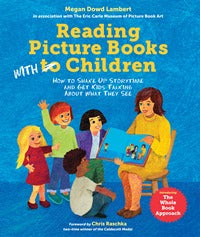 This week marks the one-year anniversary of the publication of my book introducing the Whole Book Approach, Reading Picture Books with Children: How to Shake Up Storytime and Get Kids Talking about What They See, which I wrote in association with The Eric Carle Museum of Picture Book Art.
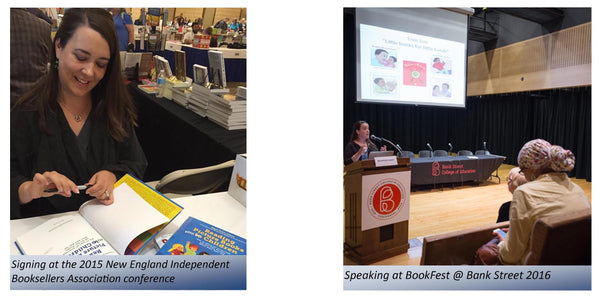
The book’s great success has been gratifying, humbling, and very exciting, and I rounded out its first year in the world with a talk at the Book Fest @ Bank Street that applied the Whole Book Approach to books by many of the other speakers who presented there including: Raúl Colón, Christopher Myers, Brian Pinkney, Pam Muñoz Ryan, Jason Chin, Angela Dominguez, Hervé Tullet, my own picture books illustrated by David Hyde Costello and Nicole Tadgell, and various titles from editor Françoise Mouly’s Toon Books imprint. (To see my talk, check out this Kid Lit TV link and go to the 2:05 mark).
Earlier in October I gave a talk at The Carle’s annual Educator’s Night applying the Whole Book Approach to some of the books illustrated by the keynote speaker, Christian Robinson. In preparation for this talk I’d visited local schools and read his books with students, so I got to share their responses to his work with him and the rest of the audience.
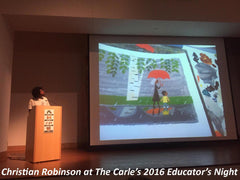 Here Christian is looking at a picture that I’d discussed with kids. The text has Nana say that the tree is “drinking through a straw” and the children read the picture and noticed that the reflection in the puddle makes it look like the tree is going down through the ground into the water, like a straw breaking the surface of the water in a glass. “That’s not what I intended, but I can’t stop seeing it now,” Christian said.
Isn’t that wonderful?
In my Bank Street talk I quoted a line from Reader Response theorist, Louise Rosenblatt, who wrote, “Books do not simply happen to people. People happen to books,” when she described reading as a “transaction” between the reader and a text. It follows that meaning resides, not in the text, but in the space between the reader and the text, and this line of thinking allows us to engage with a book and consider a multiplicity of possible meanings it might provoke depending on what the reader brings to the reading transaction.
Allowing readers to “happen to books” is at the heart of my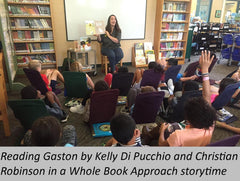 Whole Book Approach work as I center children’s responses to text, art, and design—the whole book—during storytimes. And, hearing readers’ responses to my book over this past year has been just wonderful. It’s so gratifying to know that teachers, librarians, parents, and other caregivers are reading my book and getting new tools to add to their storytime toolkits as they renew their appreciation for picture books and shore up their passion for reading with children.
An exciting surprise is that I’ve heard from many artists, writers, an publishing professionals, too. These are people who are already engaged in the creation of picture books and are using my book to augment their knowledge and refine their craft. And, several writers and artists have told me that they’ve used my book to hone storytime skills since visiting schools and libraries to lead book programming has become a big part of their promotional work.
Although I’ve had some readers reach out to me through my website, one of the main ways I’ve heard from people has been through social media. I had never even had a personal Facebook page before this year, but right before Reading Picture Books with Children came out I joined Twitter, and then a few months later I bit the bullet and set up a public author’s Facebook page. I haven’t really taken off with Facebook, but Twitter has been a great way to interact with readers, learn from others in the field, and otherwise immerse myself in a community of people passionate about children’s literature. I am daily grateful for the connections I’ve made there and for the ways it allows me to grow as a writer, a teacher, and a reader.
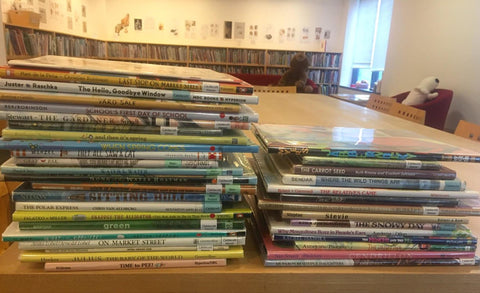
November 2016 is Picture Book Month, and I will draw upon my book to tweet about picture book art and design. I'll feature new books each day that make the most of design and production elements including: trim size and orientation; jackets and cases; endpapers; front & back matter, typography; and page design elements such as framing, pageturners, and the gutter. Follow along and enjoy!
I have lots of other projects and events on the horizon related to this book, including a guest lecture in a Book Studies course at my alma mater, Smith College, a Skyped Whole Book Approach training with educators in Indiana, and a workshop at a public library in Massachusetts, among other plans. And, of course, I will keep reading picture books with children. I have other writing projects in the works, too—essays, picture book texts, and more Whole Book Approach storytime documentation.
Thanks to everyone who helped make this first year of my book’s publication a success—especially to my readers and to the many people at Charlesbridge, The Carle, and Simmons College who have supported me as I’ve stepped into the role of author. I am hoping my book will appear on lots of holiday shopping lists for teachers, librarians, writers, illustrators, parents and other caregivers (a portion of all royalties goes to support The Carle and you can purchase signed copies through The Carle’s Shop), and I am always eager to hear from readers about their Whole Book Approach experiences.
Happy Whole Book Approach reading to all,
Megan
- Donna Spurlock
- Tags: children's books literacy reading storytime whole book approach Yolanda Scott